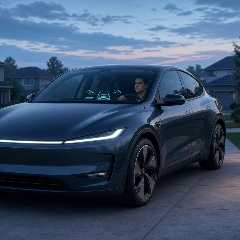

If you are shopping for an electric car with “self-driving” features, the most important question is not how the marketing sounds. It is what you are legally allowed to buy, and what kind of license you still need to use it.
Here is the short version from current reporting and official pages: you can buy many electric cars with advanced driver assistance today using a normal driver’s license. You cannot buy a fully driverless car at a dealership. Robotaxis are a ride you hail, not a vehicle you take home.
What you can buy with a standard driver’s license
Every consumer car sold for private use in the United States still assumes a licensed human driver. That includes electric models with lane keeping, adaptive cruise control, and systems marketed with strong names.
Edmunds’ August 13, 2025, long-term update on a 2026 Tesla Model Y is a clear consumer example. All Model Ys come with Autopilot, which Edmunds describes as adaptive cruise control, lane keeping, and lane centering. Full Self-Driving (Supervised) is a separate paid option—Edmunds put the price at $8,000 for the current Model Y lineup—or it can come included on certain loaded trims. The system can change lanes, handle city streets, and follow navigation, but Edmunds quotes Tesla’s own owner’s manual: it is a hands-on feature that requires the driver to pay attention and be ready to take over.
A February 20, 2025, Center for Auto Safety summary of autonomous vehicles makes the same industry point in plain language. Jeff Farrah, CEO of the Autonomous Vehicle Industry Association, said there is no car you can buy from a dealership today that is fully self-driving. That includes Teslas running Full Self-Driving in supervised mode. Drivers still need to closely monitor the vehicle.
BUYING AN EV WITH DRIVER ASSIST IS NOT THE SAME AS BUYING A DRIVERLESS CAR.
What “self-driving” usually means on a car you own
San Francisco’s Municipal Transportation Agency draws a useful line. Advanced Driver Assistance Systems (ADAS)—automatic emergency braking, forward collision warning, lane departure warning, and similar tools—are built to support a human driver who remains fully responsible. The SFMTA page states that even Tesla’s “Full Self Driving” software is an ADAS feature: the driver must keep paying continuous attention and maintaining control.
LegalClarity’s April 1, 2026, explainer puts that in licensing terms. Cars you can buy today sit in the driver-support levels of the SAE automation scale. Tesla Autopilot and GM Super Cruise are described there as Level 2 systems: they assist; they do not replace you. A valid driver’s license is required to operate them on public roads. Sitting behind the wheel of a car with steering controls still makes you the operator under current law.
So the licensing answer for a privately purchased EV is simple: a standard driver’s license is enough, and still required. No extra special “self-driving license” is sold with these cars. The catch is the opposite of what the ads sometimes imply—you do not get to stop being the driver.
What you cannot buy (yet)
Fully driverless vehicles are a different category. The SFMTA states there are no autonomous vehicles currently on the market for purchase in the United States. Those fleets are operated by their developers. Waymo, Zoox, and similar services are robotaxis or company-controlled fleets, not consumer products you register like a family SUV.
LegalClarity notes the passenger side of that split: if you ride in a Level 4 driverless robotaxi with no expectation that you will drive, you are a passenger, and a driver’s license is not required to ride. That is not the same as buying the vehicle. Company permits, insurance rules, and city or state deployment approvals sit with the operator, not with a private buyer at a dealership.
What this means for you
- If you want an electric car you can purchase and drive yourself, shop normal consumer EVs. A standard driver’s license is what you need, and what the car still assumes you have.
- Treat “Full Self-Driving,” “Autopilot,” “Super Cruise,” and similar names as supervised driver assistance unless an official page and your state rules say otherwise. Keep your attention on the road.
- If you want a ride with no driver, that is a robotaxi or similar service in cities where it is allowed—not a car you buy and park at home.
The useful distinction is purchase versus ride, and assistance versus autonomy. One you can buy today with a regular license. The other is still a service, not a showroom option.
Sources
- Brent Romans, “Is Our Tesla Model Y’s Full Self-Driving Tech Really Worth $8,000?” Edmunds, August 13, 2025: https://www.edmunds.com/car-news/2026-tesla-model-y-full-self-driving-long-term-update.html
- Rebecca Ruiz, “Robot, take the wheel: What you need to know about autonomous vehicles rolling out across the U.S.,” Center for Auto Safety (Mashable summary), February 20, 2025: https://www.autosafety.org/robot-take-the-wheel-what-you-need-to-know-about-autonomous-vehicles-rolling-out-across-the-u-s/
- San Francisco Municipal Transportation Agency, “Autonomous Vehicles (AVs) in San Francisco”: https://www.sfmta.com/projects/autonomous-vehicles-avs-san-francisco
- LegalClarity, “Do You Need a Driver’s License for a Self-Driving Car?” April 1, 2026: https://legalclarity.org/do-you-need-a-license-to-drive-a-self-driving-car/